Below the Surface: How Land, Water Rights, and Mineral Adjacencies Are Quietly Redefining Coal Property Valuations
Rethinking What a Coal Mine Actually Is
A coal mine, viewed narrowly, is an extraction operation: capital deployed to recover a commodity from the earth, generate cash flow, and eventually reclaim the disturbed land. Viewed more broadly, it is a bundle of property rights—surface, subsurface, mineral, and water—assembled over decades and often carrying value that has nothing to do with the coal itself. The distinction matters enormously for investors willing to look past near-term tonnage economics.
This broader view is not a novelty. Timberland companies have long been valued partly on the optionality of their land holdings. Oil and gas operators routinely assign value to acreage that has not yet been drilled. Yet coal equities are rarely analyzed through a comparable lens, in part because the sector's investors have historically focused on production metrics and in part because the non-coal assets embedded in mining properties are genuinely difficult to value without granular knowledge of specific parcels.
That analytical gap creates opportunity for investors willing to do the work.
Water Rights: The Underappreciated Asset on Every Mine Balance Sheet
Coal mining requires substantial water for dust suppression, coal washing, and slurry transport. To secure these needs, operators have historically acquired water rights—sometimes surface water allocations, sometimes groundwater permits—that represent legally protected entitlements independent of the mining operation itself.
In the arid and semi-arid regions of the western United States, water rights carry explicit market values that can be substantial. Wyoming's Powder River Basin, home to some of the nation's largest surface coal operations, sits within a water rights framework where senior appropriation rights have traded at meaningful premiums as agricultural, municipal, and industrial demand has grown. A coal company holding senior water rights in this basin possesses an asset that would retain value even in a scenario where the underlying coal operation ceased.
In Appalachia, the picture is different but no less interesting. The region's complex hydrology and the regulatory requirements associated with mining permits mean that operators have accumulated detailed knowledge of local water systems and, in many cases, hold permits and infrastructure that could serve post-mining industrial or agricultural uses. While these rights are less directly marketable than western appropriation rights, they represent a form of optionality that balance sheet analysis rarely captures.
Rare Earth and Critical Mineral Adjacencies
Perhaps no dimension of coal property value has attracted more attention in recent years than the presence of rare earth elements and critical minerals in coal seams, coal refuse, and the surrounding geology. Research conducted through the Department of Energy's National Energy Technology Laboratory has confirmed that certain Appalachian coal deposits contain meaningful concentrations of elements including neodymium, dysprosium, and cerium—materials essential to electric vehicle motors, wind turbines, and defense applications.
Natural Resource Partners, one of the largest coal royalty and natural resources companies in the United States, has explicitly positioned its land holdings as a platform for critical mineral development alongside coal royalties. The company's Appalachian acreage includes properties where rare earth extraction from coal refuse piles has moved from laboratory research toward early-stage commercial evaluation. For investors, this represents a genuine optionality play: the rare earth value is not currently priced into coal equity valuations, but it is not hypothetical either.
Archaea Energy's work on coal mine methane and the broader interest in mining coal ash ponds for germanium and gallium—both classified as critical minerals by the U.S. Geological Survey—add further dimensions to this picture. Coal ash, long viewed as an environmental liability, contains recoverable concentrations of several critical minerals at grades that are increasingly economic given current pricing.
Land Repositioning: From Mine to Something Else
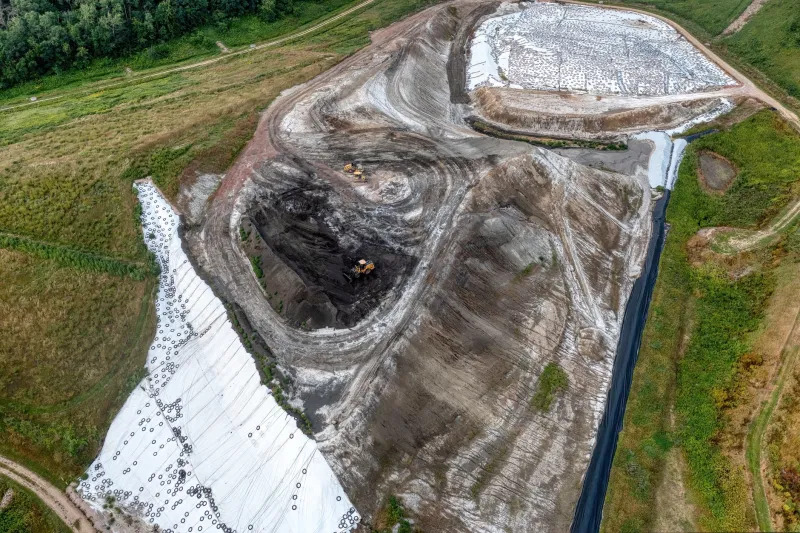
Reclaimed coal mine land has a documented history of productive reuse. Solar installations on reclaimed surface mines in Appalachia and the Interior Basin have attracted developer interest precisely because these sites offer flat or gently rolling terrain, existing grid interconnection infrastructure from former mine operations, and land that is already disturbed—reducing permitting friction relative to greenfield development.
FERC and state-level utility commissions have shown increasing receptivity to solar development on reclaimed mine land, and federal programs under the Inflation Reduction Act created bonus tax credits for energy development on so-called energy communities, a category that explicitly includes former coal mining areas. For a coal operator holding land approaching the end of its mining life, the solar optionality embedded in that acreage is a real financial consideration.
ARCH Resources and Foresight Energy have both been involved in discussions or transactions touching on post-mining land use, though the specific economics vary considerably by location, grid proximity, and state regulatory environment. The key analytical point for investors is that reclamation liability—the obligation to restore mined land—and land optionality are two sides of the same coin. A property with substantial reclamation costs may nonetheless carry offsetting value if the post-reclamation land is well-suited to alternative productive use.
Building an Analytical Framework for Hidden Asset Value
Translating these observations into a usable investment framework requires discipline. Not every coal property harbors meaningful non-coal value, and overstating optionality is as analytically dangerous as ignoring it.
A rigorous approach starts with the company's land position: total acres held, surface versus mineral rights, and geographic concentration. It then examines water rights disclosures in state regulatory filings—a source that most equity analysts never consult but that can reveal significant entitlements. Third, it assesses proximity to rare earth research programs, which the Department of Energy has mapped with reasonable granularity. Finally, it evaluates reclamation timelines against solar and other renewable development economics in the relevant geography.
Companies that score well across multiple dimensions—significant land holdings, documented water rights, geological adjacency to critical mineral research, and land suited to post-mining development—deserve a valuation premium that purely tonnage-based analysis will systematically miss. In a sector where the conventional investment narrative has grown stale, that premium may represent some of the most compelling alpha available to patient, analytically rigorous investors.